
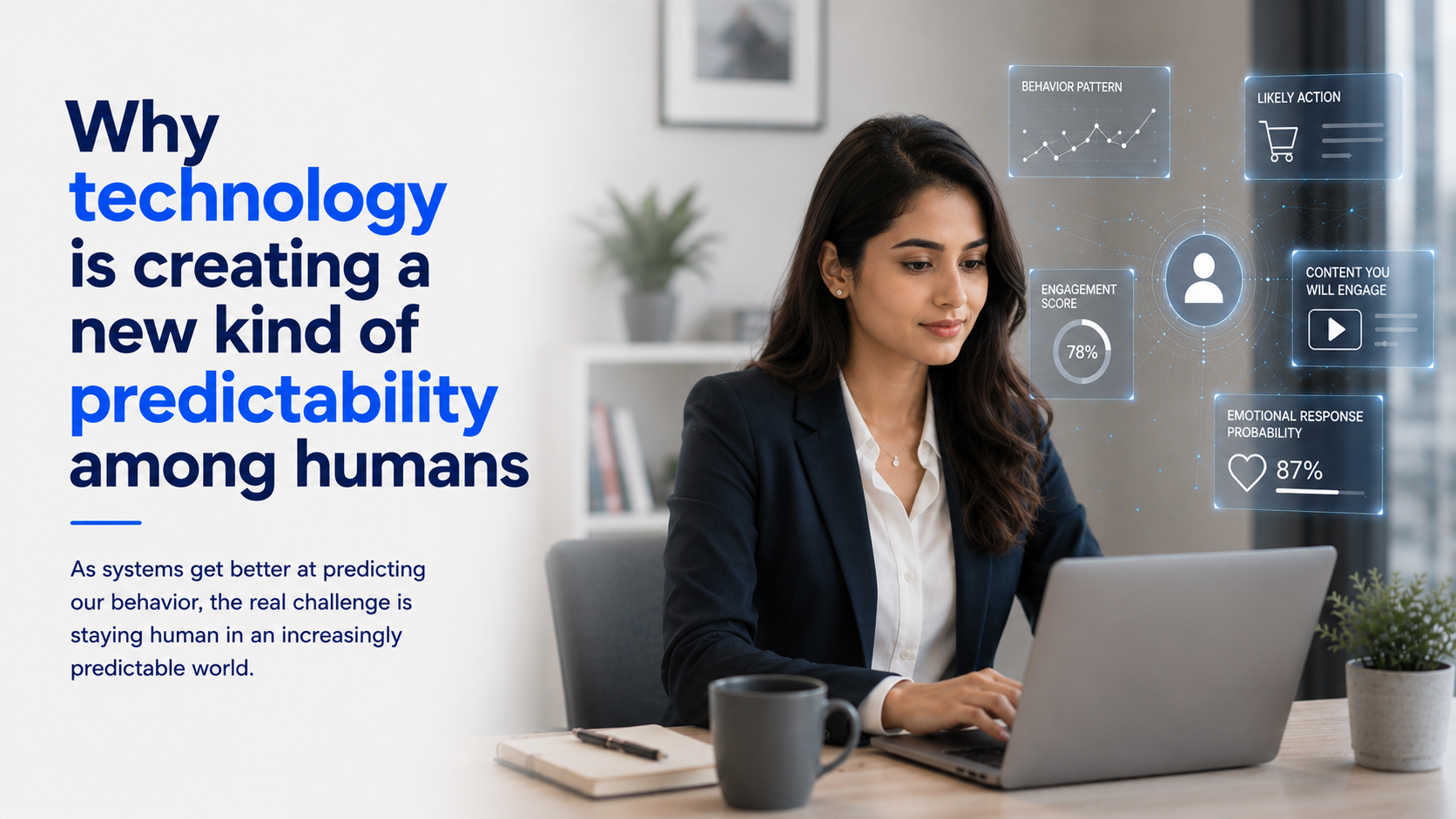
Outline: For decades, we have thought of humans as being uniquely unpredictable. However, a quiet revolution has begun to take shape at the intersection of technology development and psychological research in 2026. As technology continues to improve our ability to understand how humans react emotionally and psychologically, our behaviors, preferences, and emotional responses are becoming increasingly predictable, not because we have lost some essence of complexity, but because the systems we interact with every day are getting better at predicting exactly how we will behave before we know ourselves how we will behave.
How much do you really know about what you will click?
By the time you read the title of the last article that elicited a strong emotion from you, the platform that delivered it to you had already determined that you would click on it. This was due to the platform having watched your precise patterns of attention, hesitation, scrolling, and emotional trigger responses long enough so that it could build a model of you with a precision many would consider unsettling if they were to take just a few minutes to think about it.
This is not conspiratorial; this is simply the end product of ten years of collecting large amounts of behavioral data and applying predictive modeling techniques using AI systems to determine what each user will do when presented with certain types of content. These changes have profound implications for how we view human behavior, how companies should lead employees in 2026, and how individuals develop and cultivate greater levels of self-awareness.
According to a 2023 MIT Media Lab study, social media algorithms can predict users' emotional states (and therefore their probable next actions) based solely on users' historical behavior with up to 87% accuracy. Not what users say. Not what users report. Their behavior. Over time. The person in this model is not viewed as a complex inner experience. They are viewed as a system with known input variables and highly predictable output values.
Nobody ever discusses this feedback loop
What makes this especially relevant from a behavioral standpoint is that there is a type of feedback loop created. Systems predict how you will react to certain stimuli and present you with those stimuli. You react. The predictions get more accurate. You are shown more of what has always worked on you. Your responses become more consistent. The models tighten. Over time, the number of new stimuli that actually capture your attention in ways that produce unanticipated reactions decreases.
This is not passive. It is a shaping mechanism. Most people are participating in this shaping process without realizing it is occurring.
Implications for how we think and lead in organizations
The implications of these changes extend far beyond how we consume information via social media. The same type of predictive logic is being used to create tools that help employers predict employee engagement patterns, predict turnover risks, and identify potential conflict dynamics among team members based on how team members communicate with each other.
While this may ultimately be very useful, it also raises questions about whether the increasing use of predictive systems to model human behavior in organizations reduces the quality of human judgment, increases the likelihood of spontaneous thinking that leads to innovative ideas, etc.
Behavioral narrowing - a phenomenon worth naming
As researchers begin to realize, a phenomenon worth identifying is called behavioral narrowing. The phenomenon occurs when heavy users of predictive systems start to limit the scope of their expressed opinions/preferences/responses to those options/expressions that have historically been rewarded or validated by the systems around them.
In organizational settings, this manifests itself in meetings where all participants seem to agree because the organization has learned to predict/agree with what others want to hear. In communication processes, this results in leaders receiving responses to communications that reflect what they have habitually trained their employees to provide as answers. When brainstorming sessions occur in organizations that rely heavily on predictive systems, only ideas that are easily foreseeable extensions of existing knowledge are generated because the environment has reduced the safety net surrounding novel suggestions.
Protecting humanity’s greatest asset - unpredictability
At a point in history where our reactions are increasingly readable by systems that react to our readability, humanity's greatest asset is not cognitive abilities or creative abilities. Its greatest asset is the capacity for true unpredictability. The capacity for surprising oneself. The capacity for reacting to something in a manner that no prior behavioral data would have predicted. The capacity for thinking thoughts that no prior model saw coming.
Unpredictability does not sustain itself under conditions where environments exist to predictably validate past behaviors. It needs to be cultivated through familiarity with unexplored ideas, relationships with people who think differently, and an intentionality to avoid the comfort zone offered by algorithmic validation and instead choose to tolerate uncertainty.
Cultivating and maintaining your unpredictability in 2026 may be one of the most subversive acts of courage any thinking person can undertake!