
During the early stages of establishing our content operation, we priced our services at levels that appeared to be competitively comparable to the prevailing freelance rates for content service providers in the UK. At the time, most other agencies were charging clients between £800 and £1,200 per month for virtual assistant support; therefore we elected to position our services at £999 per month so as to provide a slightly higher margin than our perceived competitors but still appear competitive. We used this pricing model for the first four years. During this period the size of our team increased along with the range of our capabilities. The number of accounts we serviced grew from 12 to 50 and eventually to more than 200. In general our revenues have grown due to the fact that we were servicing additional clients and not necessarily because each client was paying us more for our services. Over time our operating margins compressed steadily as our costs increased.
In addition to the above factors, by year 5 (the second quarter), the math behind pricing had become unsustainable. For example, senior writers earn considerably more than junior writers. Additionally, managing 50 client relationships requires significantly more infrastructure than managing 12. As such, our compliance and quality control costs increase linearly with client count. In essence, our pricing model of £999 per month has been providing increasing amounts of subsidies for growing complexity with decreasing returns per client relationship.
It was during a pricing analysis meeting, during which we analyzed our actual cost to serve each client compared to the revenue generated from each client, that we realized some accounts were marginally profitable, while others were losing money even after accounting for total operational expenses. We were unknowingly cross-subsidizing low-margin clients with profit from high-margin clients. Such a pricing structure is likely to collapse catastrophically once you hit a certain scale.
What Pricing Really Represents
Most content agencies use one of three flawed models to determine how to price their services. First, they compare themselves to their competitors to determine what the "market" rate is. Assuming that there is an actual "market" rate that reflects what consumers are willing to pay. Second, they determine their pricing using a "cost-plus-margins" model. Adding a predetermined percentage to their operational expenses without determining if the resulting price represents the true demand for the service. Third, they do not change their pricing over long periods of time, regardless of changes in the operational complexity of their business.
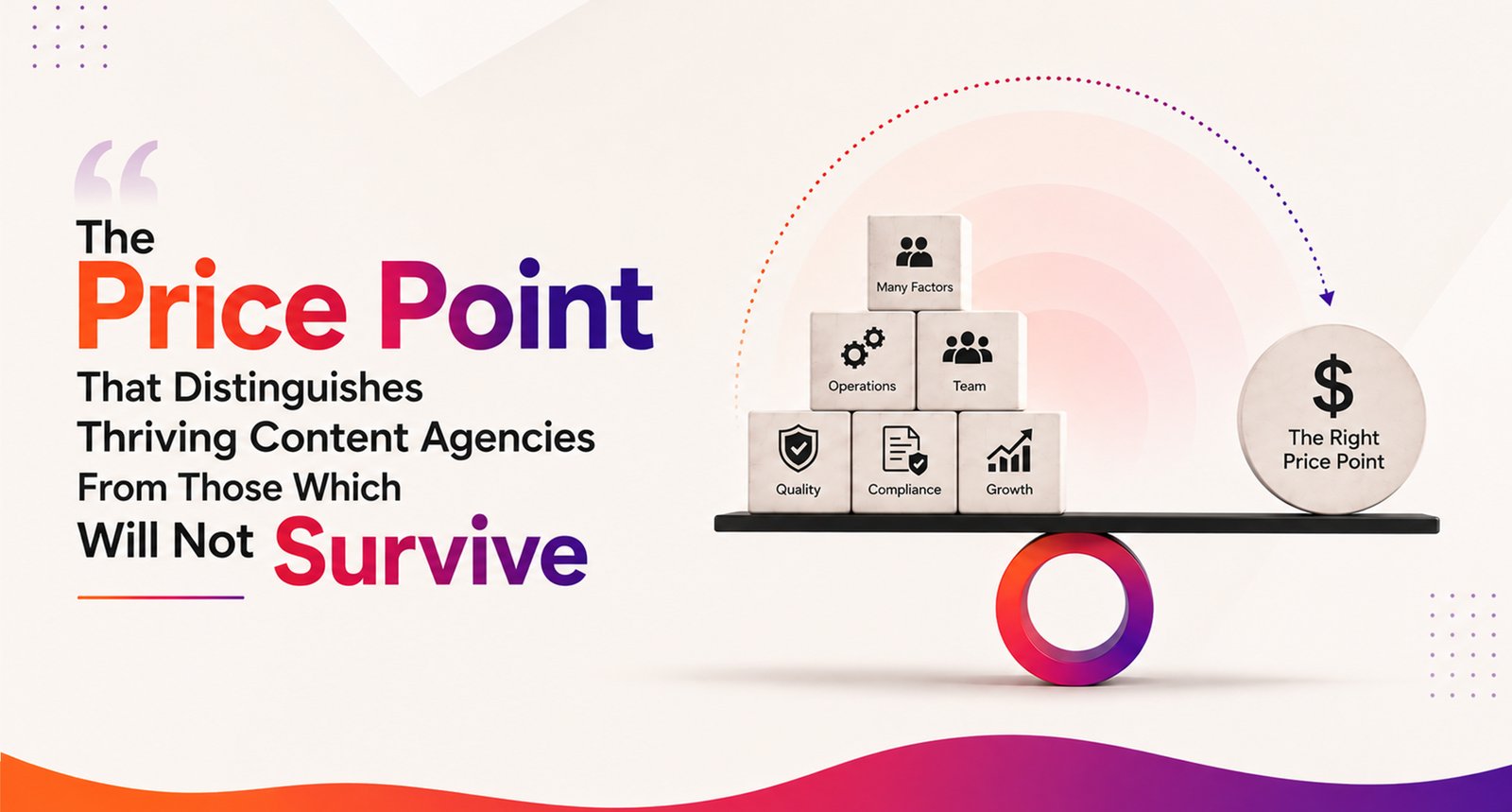
Each of these models fails to recognize that pricing represents the value you are able to offer clients relative to alternative methods of obtaining similar products or services. If a client can obtain the same amount of content through a freelancer for £500 per month vs. hiring an agency for £1,500 per month, then ultimately, the client is comparing these two options based on perceived differences in terms of risk, quality, strategic guidance and reliability. Therefore, pricing should reflect the value you bring to your clients across all of these areas, rather than simply the quantity of output created.
Based upon this understanding, we completely revised our pricing model by identifying the key factors clients valued in working with our agency. Most did not focus on producing a large amount of content. Rather, most focused on creating content that would push potential customers towards making a purchase. More than anything else, they valued consistency and reliability in creating content. Finally, they valued strategic advice regarding what types of content they should produce, rather than simply executing their ideas.
As a result of this new understanding, we changed the way we approached pricing. Specifically, we transitioned away from using monthly retainer fees for completing tasks and began using value-based pricing that was linked to specific client outcomes. In essence, what are you attempting to accomplish through your content? How much revenue would improved content marketing generate? What portion of that improvement should we receive?
At first glance, this type of pricing may seem aggressive. However, when you consider what this pricing structure actually accomplishes, it becomes clear that it creates alignment between our incentives and those of our clients. Simply put, we only make more money if our clients achieve their desired outcomes. Secondly, this pricing model acts as a filter for potential clients. Clients who desire low-cost volume will look elsewhere. On the other hand, clients who seek a strategic partnership with measurable results will continue to partner with our company.
Sustainable Economic Model
After revising our pricing model and committing solely to developing strategies and solutions that drive measurable results for our clients, we achieved a client retention level of 89%. Furthermore, within an 18-month period, the average account value we captured increased 340%, while improving our overall operating margins despite having fewer clients. We stopped servicing unprofitable relationships.
Stagnant content agencies become mired in volume economics, where they must continually add more clients at lower margins in order to grow. Conversely, thriving agencies break free from this cycle by recognizing that pricing is an indicator of value delivered and not inputs provided.