
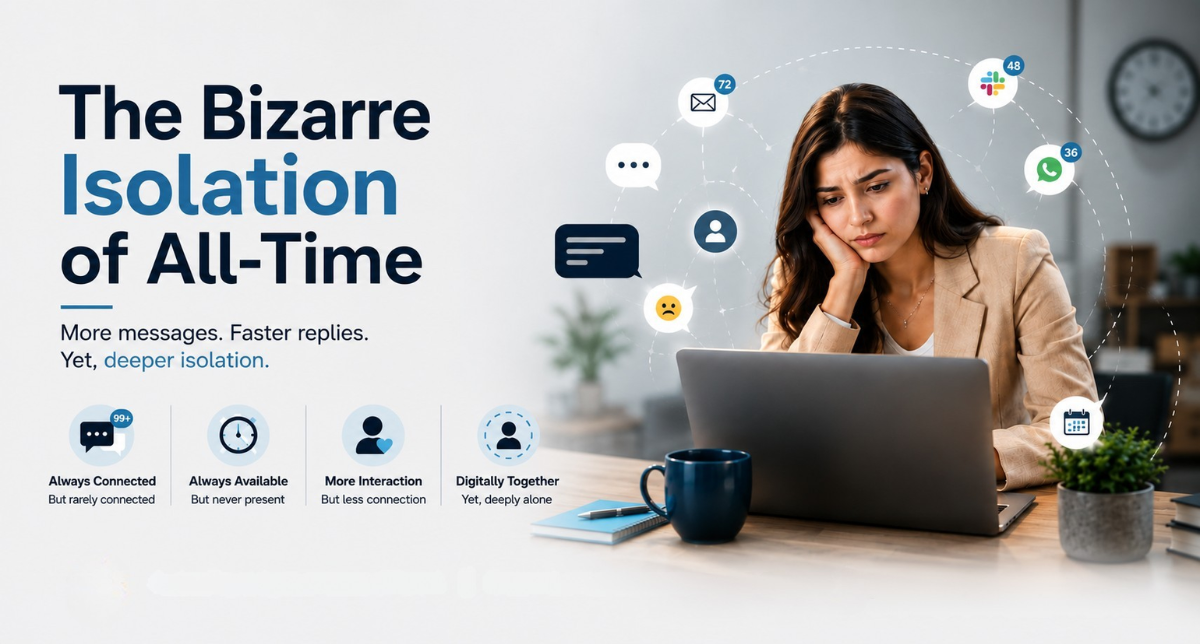
Outline: Since 2026, we have never been more accessible, more responsive, nor digitally active than we are today. Yet a quiet, consistent isolation has developed within the midst of this increased accessibility of digital communication that nearly everyone avoids addressing directly.
Less Meaningful Messages Than Ever Before
It is important to notice something: that on an average business day in 2026, an average professional exchanges (sends & receives) approximately 100–150 messages throughout the course of his/her day using such digital platforms as email, Slack, WhatsApp, and other project management tools. With respect to response times, there have never been quicker responses. There have never been greater expectations regarding availability. As a result of those increased expectations, the belief that one should be reachable has greatly increased the amount of time individuals spend awake.
However, when asked how frequently an individual feels he/she is truly understood by his/her colleagues/workplace peers, the majority of professionals provide surprising answers, "not enough," very similar to previous years. A 2023 Gallup study reported that only three out of ten employees “strongly” agreed that someone at their place of employment cares about him/her as an individual. By 2026, after remote/hybrid work became the standard practice for many knowledge-based workers, that percentage has remained largely unchanged despite the massive increase in digital communication tools designed to foster connections among coworkers. Despite additional channels and additional messages, fewer of the qualities necessary to develop actual connections exist.
Unintended Consequences
The irony deserves consideration, as each communication platform was created to enhance workplace communications with good intentions. Responding quickly, eliminating silos, increasing transparency, and improving alignment were not cynical objectives. However, due to the accumulation of always-on communication environments over time, an unintended consequence occurred, a type of relational fatigue that coincides with extensive social interactions.
Isolation is defined by many researchers as the lack of true contact. True contact can occur via either face-to-face or phone communication. Many types of digital communication, regardless of frequency or positive intent, do not produce feelings of connection as humans are biologically predisposed to require.
Losses Due To Optimizing Digital Communications
The unique aspects of unstructured human conversations (that few digital formats replicate) include: conversational digressions devoid of agendas; silent pauses that communicate comfort vs. discomfort; nonverbal cues/expressions conveyed via facial expressions; shared physical spaces that create feelings of presence/being physically present. No matter how high-resolution video calls may be, they have not replicated these aspects. These are significant losses. These are the nuances that allow humans to form the types of relationships that make work feel meaningful versus transactional.
Leadership Attention Gaps in Measurement
Organizations generally measure employee/team health by administering surveys (employee engagement), conducting pulse checks, and tracking productivity metrics. Relational depth (whether employees feel seen, experienced moments of authentic humanity during their working hours, and whether they view their workplace relationships as nurturing vs. merely functional) is generally not measured. The disconnect between the two (measurement and attention) demonstrates a clear leadership gap in 2026. That gap is reflected in the gradual disengagement from work demonstrated by individuals who respond consistently but feel profoundly disconnected simultaneously.
Realization Worth Embracing
Availability and presence are different states of existence; responsiveness and connection are also different states. Building an effective communication infrastructure (fast, efficient, low-friction) is not equivalent to creating teams where members feel a belonging to each other.
The strangeness of the loneliness generated by continuous online communication is directly related to its ability to hide within the appearance of togetherness. Until organizations begin to measure the elements of connection that relate to humans at work, they will continue to confuse busyness with closeness.